From KPIs to Flows
Why Regeneration Fails When We Try to Reach It With a Business Model

This week, Fabrício Peres - an executive leader in global agribusiness and food supply chains—published a piece arguing that regenerative agriculture is not a goal but a risk strategy. His diagnosis is sharp: companies jump on the regenerative wave without understanding the business problem they’re trying to solve, leading to permanent pilot mode, unclear metrics, frustrated teams, and programs that die when budgets tighten or leadership changes.
He’s seen it repeatedly - companies embrace regenerative agriculture because the narrative is strong and expectations are rising, but they neglect the foundational question: What problem is this approach meant to solve? The result is years of well-intentioned initiatives with no strategic anchor, guided more by the momentum of the trend than by the needs of the business.
In the conversation that followed his post, Fabrício asked me a question that cuts even deeper: “How do you see scalability without business drivers?”
I think my answer surprised him. And it might surprise you too.
Because the problem isn’t that regeneration lacks business drivers. The problem is we’ve been looking at the wrong drivers all along.
The Translation Leaders Have Been Missing
For decades, leaders have been taught one foundational belief: if you optimize your business model, the organization becomes healthier.
Strategy manuals, investor decks, operating models - all of them assume the same thing. Make the numbers better, and the system will follow.
But regeneration doesn’t follow business-model logic. It follows living-system logic.
And the moment you start translating between the two, you see something that changes everything: The metrics we optimize for are not the flows that keep the system alive.
That’s why regenerative programs die in year two, even when leadership understands the business case.
Here’s the core problem: business models measure transactions; living systems measure flows.
Once you translate familiar KPIs into their metabolic equivalents, the mismatch becomes obvious:
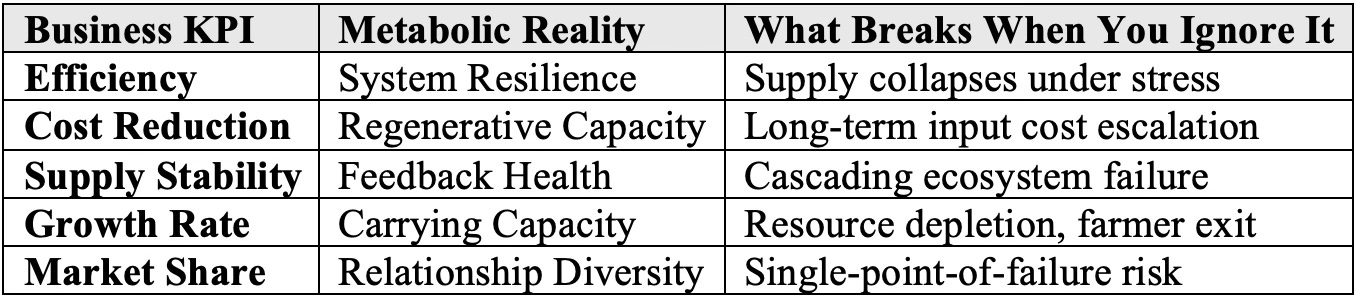
Most businesses optimize for the left column. Regenerative systems depend on the middle column. The right column shows what happens when you ignore the middle long enough.
But here’s the part the regenerative field doesn’t always say clearly enough: This isn’t an anti-business argument. It’s a pro-continuity argument.
Why This Matters Economically (Not Just Ecologically)
When companies start managing flows instead of just KPIs, they don’t lose competitiveness. They actually gain what every CFO claims to want:
Lower volatility - because upstream systems stop collapsing mid-quarter
Supply stability - because ecosystems stay within regenerative capacity
Predictable costs - because degradation becomes prevention, not emergency repair
Competitive moat - because competitors still optimizing for extraction will hit biological limits first
In other words: Regenerative metabolism doesn’t fight economic value. It stabilizes it over time horizons that actually matter.
Ask any coffee roaster: what looks like a margin problem today is usually a soil-capacity problem that’s been building for decades.
Once you see this pattern, you can’t unsee it.
A Concrete Example: Coffee
Take coffee - an industry where climate volatility, soil decline, and farmer attrition are now well-documented.
A traditional business model sees:
Higher upstream costs
Unstable yields
Supply shortages
Price volatility
A metabolic model sees:
Declining soil organic matter
Stressed watersheds
Failing nutrient cycles
Ecosystem feedback loops going unmet
These aren’t “margin problems.” They are depletion problems.
And unless companies learn to see, and manage, these underlying flows, no amount of strategy will stabilize their supply or their economics.
Take Heirloom Coffee Roasters. They don’t just source from regenerative farms. They manage the metabolic flows those farms depend on:
They track soil organic matter accumulation, not just yield per hectare
They monitor farmer retention and training expansion (215 farmers at their Peru partner farm alone), not just contract compliance
They measure watershed protection and biodiversity indicators, not just farm-level certification
They invest in compost infrastructure and agroforestry systems, not just input subsidies
This isn’t altruism. It’s metabolic literacy translated into supply chain resilience.
And it’s why their costs stay stable while competitors face climate-driven volatility and farmer exit that threatens their entire supply base.
Where Fabrício’s Argument and Mine Converge
This is where the operational meets the systemic.
Fabrício is absolutely right that companies need to define the business problem before designing regenerative programs. That companies need baselines, governance structures, agronomic expertise, and measurement architectures that support operational decisions rather than just reporting requirements. That regeneration fails when it’s treated as a goal instead of a risk management strategy.
His work focuses on helping companies implement regeneration correctly by establishing soil baselines, building farmer relationships, creating data that drives decisions rather than just satisfies reporting requirements.
But here’s what I’d add: Even when companies correctly diagnose the business problem - supply volatility, farmer turnover, declining quality, climate risk - they often try to solve it using the wrong operating logic.
They’ll identify soil degradation as the root cause of supply instability. Good diagnosis. But then they’ll try to fix it by optimizing supplier management KPIs, adjusting procurement contracts, or adding regenerative practices to certification checklists.
They’re seeing the metabolic problem but reaching for mechanical solutions.
That’s why even well-designed programs get stuck in pilot mode. Not because the diagnosis is wrong or the implementation is poor, but because the metabolism underneath the business model hasn’t shifted.
You can have perfect baselines, clear governance, and farmer buy-in.. and still fail at regeneration if you’re optimizing for efficiency when the system needs resilience, or cutting costs when it needs regenerative capacity.
The Real Reason Regeneration Fails in Organizations
It’s not because leaders don’t care.
It’s not because sustainability teams aren’t trying.
It’s not because consumers won’t pay more.
It’s not even because companies skip the implementation basics Fabrício outlines.
It’s because we’re trying to reach regeneration with the wrong operating logic—optimizing machines when we need to tend metabolism.
Regenerative work fails when:
Strategy is updated but feedback isn’t monitored
Operations shift but upstream capacity keeps declining
New goals are set but underlying relationships don’t change
ESG is added but the company still extracts faster than the system restores
Pilots launch with proper baselines but are evaluated against KPIs that can’t measure what matters
Teams collect soil data but report on cost reduction metrics
Regeneration only works when the business model is re-rooted into the living systems that support it.
That’s what a regenerative metabolism does.
From Business Model to Metabolic Model
At Carom, we frame this translation through five metabolic functions that every living system shares, from forests to coral reefs to resilient businesses:
Sense: ecological attunement, feedback, listening
Translate: meaning-making, pattern recognition, root-cause clarity
Seed: experimentation, prototyping new flows
Regenerate: restoring capacity, scaling beneficial patterns
Evolve: structural adaptation, governance, long-term change
These aren’t aspirational values. They’re operational capacities that determine whether a business metabolism can sustain itself.
When leaders adopt these functions, the business starts behaving like a living system rather than a machine. And suddenly the hidden infrastructure behind their margins becomes visible.
Soil function → input cost volatility
Water cycles → supply reliability
Biodiversity → pest/disease risk
Farmer viability → continuity
Nutrient cycling → regenerative capacity
Feedback health → early warning systems
We don’t need to force biology into finance. We need to help business see that their financial outcomes are already expressions of biological reality.
The Message Leaders Aren’t Hearing Enough
Regeneration isn’t a cost. It’s continuity.
It isn’t a brand story. It’s risk management.
It isn’t a certification. It’s ecosystem health.
It isn’t a sustainability upgrade. It’s a metabolic shift.
You don’t get regeneration by improving your business model. You get it by improving the metabolism that sits beneath it.
And once you see metabolism, you can’t unsee it.
Back to Fabrício’s Question, and His Point
Fabrício argues that regenerative agriculture succeeds only when it stops being a slogan and becomes a structured approach to risk management. That companies need to start by asking: “What risk must this program solve?”
I agree completely. And I’d add: Once you’ve defined that risk, make sure you’re measuring the flows that create or mitigate it, not just the KPIs that report on its symptoms.
His question “How do you see scalability without business drivers?” points to the same gap.
We’re already scaling with business drivers. We’ve just been measuring the wrong ones.
Supply stability. Input cost predictability. Farmer continuity. Climate resilience. Soil function. Watershed health. Regenerative capacity.
These aren’t externalities. They’re metabolic indicators that determine whether your business can scale sustainably or whether it’s scaling toward collapse.
Fabrício is working on the implementation architecture - the baselines, governance, measurement systems, and agronomic rigor companies need to make regeneration operational. His work ensures that when companies commit to regeneration, they’re doing it with clear business logic and measurable outcomes.
I’m working on the paradigm shift that makes that implementation possible, helping companies see that the flows they’ve been treating as externalities are actually the drivers their business depends on. That the KPIs they’ve been optimizing are shadows of metabolic realities they need to manage directly.
Both are necessary. Neither is sufficient alone.
The companies that get both right - the operational rigor AND the metabolic literacy - will thrive.
The ones that keep optimizing KPIs while ignoring flows, or that launch well-intentioned programs without addressing root metabolism, will wonder why their margins keep shrinking and their regenerative programs stay stuck in pilot mode.
Which drivers are you managing for? And which operating logic are you using to reach them?
If You Want to Go Deeper
I’m unpacking this further for members inside the Regenerative Innovation Community including:
Tools to map your organization’s metabolic flows
How to diagnose metabolic degradation before it shows up in financials
How to translate KPIs into metabolic indicators
How to build your own Metabolic Evolution Pathway
The first Regenerative Innovation Lab opens in January in the Bay Area—a practice field for working through these translations together in small groups.
If you’re ready to examine your metabolism and not just your model, join us.
Thanks to Fabrício Peres for the provocation that sparked this piece. If you’re working on regenerative agriculture implementation at scale, his Beyond Harvest newsletter is essential reading.