The River Inside You
What the plastic in our bodies reveals about the metabolism we've built

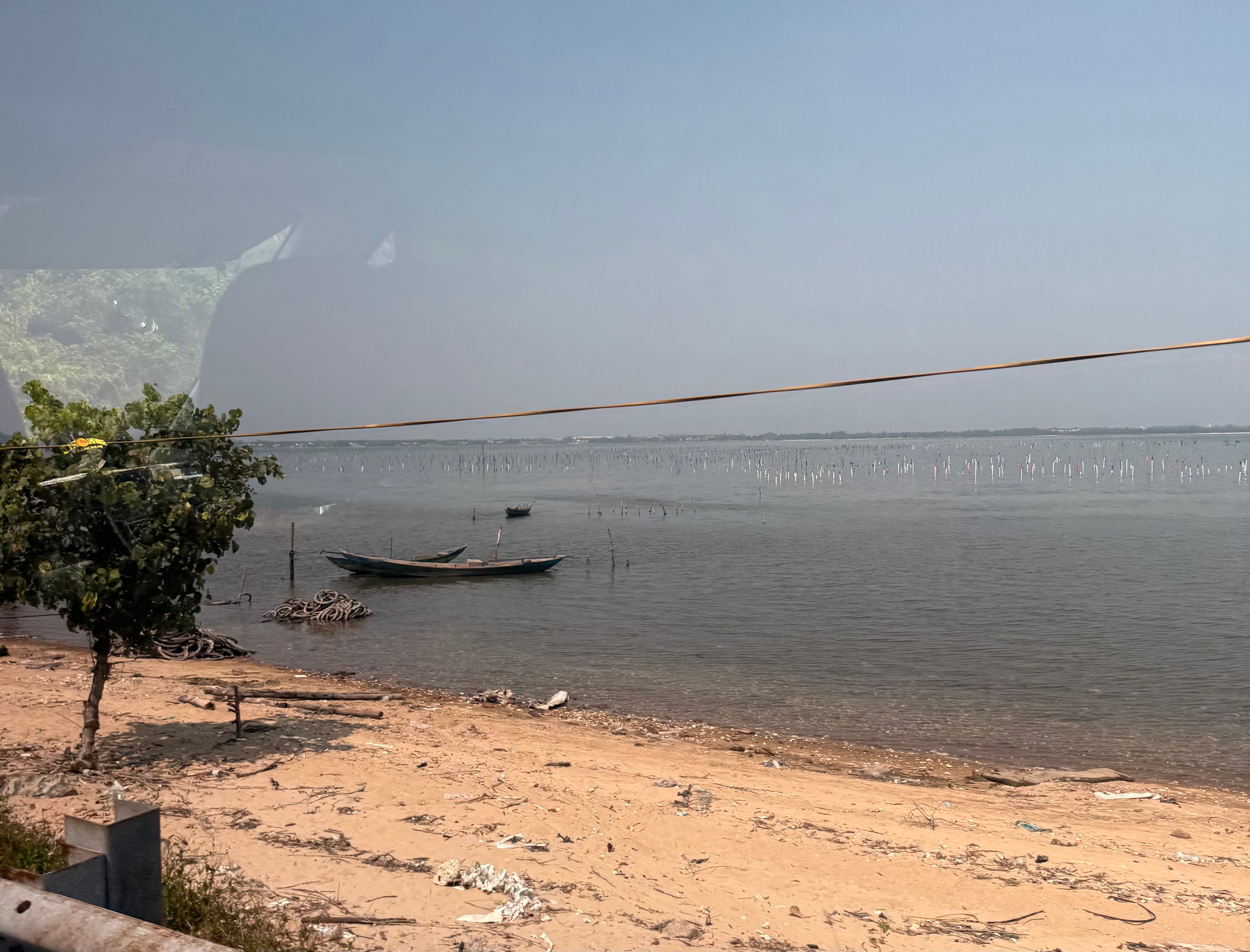
I almost missed the reflection. Maybe because I tried to avoid having it in the picture.
I was in a shuttle between Da Nang and Huế when Lăng Cô lagoon (a stretch of water locals have named and navigated for generations, one of the most beautiful coastal landscapes in Vietnam) appeared in the window - wide, calm, luminous in the midday haze. It’s the kind of water that makes you reach for your phone before you’ve consciously decided to, beautiful in the way coastal Vietnam is relentlessly, almost unfairly beautiful.
And then as I snapped some photos, the foreground came into focus.
Plastic. Accumulated at the waterline, in the grass, along the shore. Bags, wrappers, fragments of things that had already lost their original shape. It wasn’t a dramatic scene.. no floating islands of debris, no obvious catastrophe. It was just the quiet, ordinary presence of materials that had traveled here from somewhere else and had nowhere left to go.
I took the photograph. A few of them as we drove along. And it was only later, looking at them again, that I noticed what the glass had done.
The shuttle window had superimposed a faint reflection onto my picture of Lăng Cô. My world (the interior of the vehicle, the passengers, the traveler holding the phone) laid transparently over the shore, the water, and the plastic. I could see observer and observed in the same frame. The distance between them already dissolved, and at that time I hadn’t noticed.
Just over a week later I was sitting in a room in Berkeley during SF Climate Week, watching an educational version of documentary called The Plastic Detox. And then the photographs, and what the glass had quietly done to them, started to mean something I hadn’t yet been ready to see.
What the Lagoon Knows
The plastic on that shore didn’t originate there.
Vietnam receives what the global system produces through ocean currents, through river systems, through the ordinary movement of materials that cannot return to living systems and so accumulate wherever the current slows.
But there’s a harder version of this story that the Lăng Cô photograph is also telling. Vietnam isn’t just receiving the Global North’s plastic. It’s been incorporated into the Global North’s production metabolism. The factories assembling the synthetic garments worn in San Francisco and London and Tokyo are increasingly located in Da Nang, in Ho Chi Minh City, in the industrial corridors along the very coast I was traveling through. The value extracted from that production though? That flows north and west. The metabolic cost of the microplastics in the waterways, the chemical runoff in the soil, the synthetic fiber waste in the rivers.. that all stays.
Vietnam’s metabolic coherence - its food culture, its relationship to land and water, its relatively low position on the global overshoot calendar - is being interrupted not just by plastic arriving from elsewhere but by being embedded in the production metabolism of the system that creates the plastic in the first place.
The shore receives what the system produces.. and that system is increasingly located here.
This is the metabolic interruption made geographical. Materials that cannot return to living systems, produced in communities that had limited voice in the production decisions, accumulating in the very ecosystems those communities depend on.
The photograph is a document of externalized cost. The reflection in the glass is a document of who bears it.
The Journey From Shore to Body
What the documentary made impossible to unsee is the continuation of the same journey.
The plastic visible in the lagoon photograph doesn’t stop at the waterline. It enters the food chain through fish and shellfish, through the organisms that filter water, through the agricultural soil irrigated from contaminated waterways. And also through ingestion, measurable and increasingly documented.
But ingestion is only one pathway.
The same synthetic materials, the same petrochemical compounds, the same microplastic particles enter the human body through skin contact. Even through the polyester or blend t-shirt you wear against your skin all day. Or from the synthetic fleece blanket you sleep under. The carpet beneath your bare feet. The upholstery of the chair you’re sitting in. Even from your underwear - the most intimate fabric contact in daily life, against some of the most absorptive tissue in the body that’s potentially the most direct route of synthetic chemical exposure most people will never think to examine.
The domestic material environment is a continuous low-level exposure landscape.. not in a dramatic way and often not even visible. It’s operating at the same quiet, ordinary scale as the plastic accumulated along a lagoon shore between two cities.
Everywhere. All at once. Already inside.
Microplastics have been found in human blood, breast milk, in placentas - the tissue that forms specifically to protect a developing fetus from environmental contamination, and that is now documented to contain the kind of contamination it was designed to prevent, in lung tissue, arterial walls, even in the bodies of newborns who have never touched plastic directly, who now arrive in the world already carrying what the system produced before they existed.
Dr. Shanna Swan, whose epidemiological research on endocrine-disrupting chemicals is foundational to the documentary, has spent decades documenting what synthetic compounds do to reproductive systems. The research documents fertility decline across populations, earlier onset of menstrual cycles in girls, declining sperm counts, cancers across sexes, and hormone disruption that operates not through dramatic acute exposure but through the same quiet, ordinary accumulation visible in the lagoon photograph.
The documentary’s directors acknowledged that their narrative outpaces what any single study can prove conclusively. The science is still developing so the full health implications are not yet known.
But the direction is clear. And the precautionary principle applies with force when the substance in question is already present in placental tissue.
Nested Metabolisms
Here’s what I’ve started to understand even more deeply since returning from Vietnam and sitting in that room in Berkeley.
The reason I’ve built my work around metabolism, the reason it works as a diagnostic at every scale I’ve applied it to, from a clothing brand’s supply chain to a financial institution’s underwriting criteria to a national economy’s relationship with living systems is that ‘metabolism’ is genuinely universal.
It operates at every scale simultaneously. Cellular. Biological. Organismal. Organizational. Ecological. Planetary. The same logic applies whether you’re examining a mitochondrion processing glucose or a watershed processing nutrients or an economy processing raw materials. Living systems metabolize.. they take in, transform, and return. When the return is interrupted, when what enters cannot exit in a form the system can use, the metabolism breaks down at whatever scale the interruption occurs.
The petrochemical compounds accumulating in Vietnamese waterways and in human placentas are the same compounds. The mechanism of interruption is the same. The endocrine system - the body’s metabolic signaling network, the chemistry that coordinates hormonal cycles, reproductive cycles, developmental cycles - has no evolutionary pathway for synthetic compounds that mimic its signals. Neither does a soil ecosystem, nor does an ocean. The interruption operates identically at different addresses in the same nested system.
Earlier menstrual cycles in girls is the same story as earlier spring blooms caused by disrupted chemical signals in warming ecosystems. Declining sperm counts is the same story as declining pollinator populations. Multiple cancers driven by endocrine disruption is the same story as coral bleaching driven by thermal stress on metabolic systems that evolved within specific chemical and thermal ranges.
The body isn’t experiencing a different problem from the planet. It’s experiencing the same problem at a different address. A very local one.
This is why metabolic honesty matters beyond supply chains and certifications. It’s a diagnostic for nested living systems at every scale. And the human body is one of those scales.. perhaps the most intimate one, the one that closes the distance between abstract systems analysis and personal recognition.
The Regenerative Innovation Canvas maps six planetary systems. The same canvas applies to the biological systems inside you. The extraction that depletes soil carbon also depletes hormonal integrity. The interruption that breaks nutrient cycles also breaks reproductive cycles. The metabolic frame isn’t just a business framework with a health analogy. It’s a universal framework that applies wherever living systems metabolize.
Which is everywhere. Including here. Including us.
Why We’ve Known and Not Changed
The history of environmental communication is largely a history of trying to close a distance that just hasn’t closed.
We have photographed the plastic. We have counted it, weighed it, traced its origins, mapped its accumulation in the Great Pacific Garbage Patch and the Arctic ice and the deepest ocean trenches. We have filmed sea turtles entangled in packaging and albatross chicks fed bottle caps by parents who mistook them for food. We have published the data, screened the documentaries, organized the cleanups, passed the bans, launched the campaigns.
The system has not changed at the pace the images demand.
I don’t think it’s because people don’t care. The images produce genuine horror. The data produces genuine alarm. People feel both.. and then return to lives structured around systems that make the alternative nearly invisible.
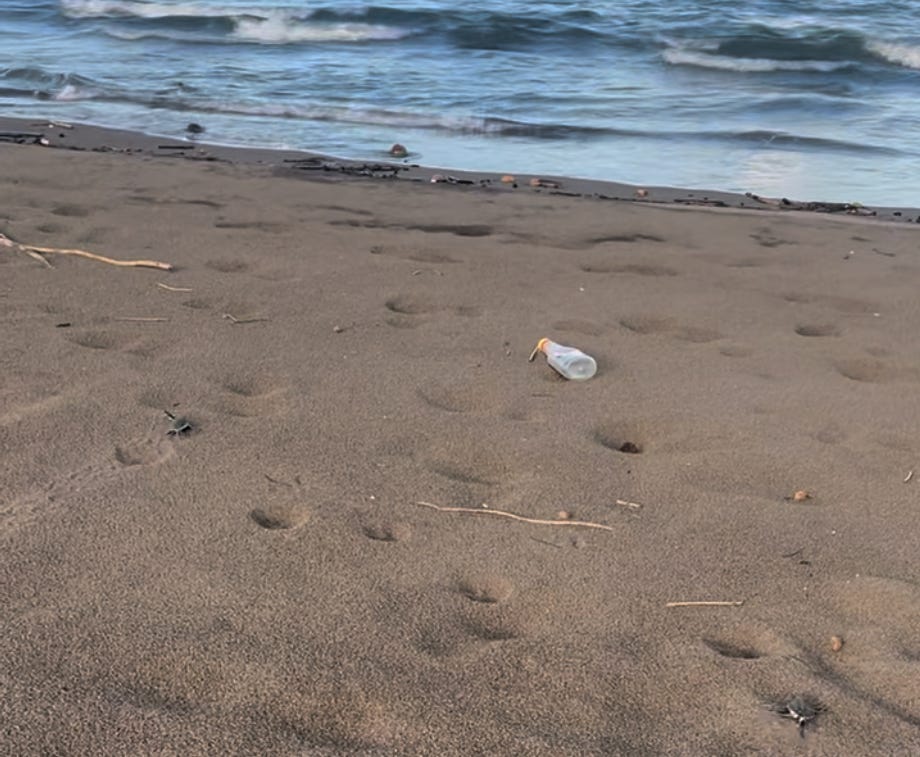
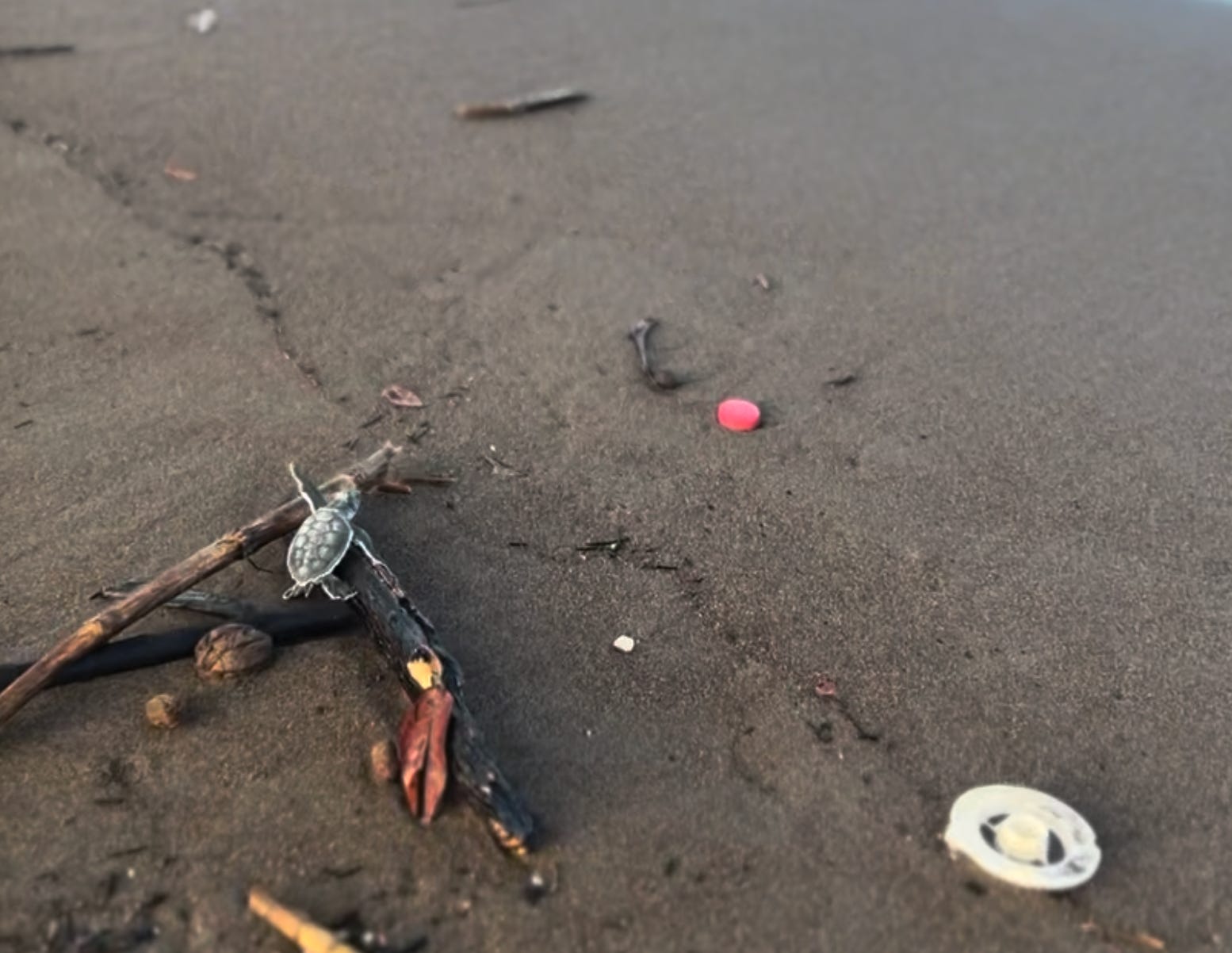
Consider Tortuguero, Costa Rica. The largest green turtle rookery in the Western Hemisphere. A National Park since 1975. The site of the longest continuously monitored sea turtle nesting project on earth — more than seventy years of protection on twenty-one miles of black sand beach accessible only by boat or foot. No roads in. No casual visitors. The most intentionally protected nesting beach in the hemisphere.
I was there. I watched baby turtles hatch and make their first journey toward the ocean.
And I photographed what was already there waiting for them.
The harm has remained external. Ecological. Distant from the daily experience of the people whose consumption patterns drive the system. You can be genuinely moved by the photograph from the lagoon and still go home and sleep under synthetic bedding and wear the polyester blend against your skin and wash it in a machine that releases hundreds of thousands of microplastic fibers into the water system.
The distance between the observer and the observed has remained intact.
What changes when the observed is inside you?
What changes when the plastic from the lagoon is in your blood, in your lungs, in the placental tissue forming around the next generation right now?
I don’t know that it changes enough. The system is more entrenched than the science is urgent, and that’s saying something. But maybe something finally shifts when the harm is no longer out there.
Seeing Differently
Since returning from Vietnam and sitting in that room in Berkeley, I’ve been seeing differently.
I don’t mean I see new things. They’re the same things, just differently.
The ‘to go’ coffee cup in all its perceived paper glory? Hot liquid leaches synthetic compounds through its plastic lining right into your drink, through the drink into the body.
The plastic water bottle? Same pathway, same destination.
The aluminum can? Also lined with plastic, same story.
The synthetic t-shirt? Dermal exposure event, repeated daily, shed into the washing machine, shed into the waterway, shed into the body of someone downstream.
The underwear? Intimate contact, absorptive tissue, continuous low-level exposure.
The carpet? The upholstery? The blanket? The mattress?
Everywhere. All at once. Already inside.
Of course I’ve known the facts for a long time. Most people reading this have too. The microplastics data has been building for years. The health implications have been surfacing in research for decades. The images from Vietnamese shores and Costa Rican beaches and the Great Pacific Garbage Patch are not new.
What’s new is the seeing.
The perceptual shift that happens when the metabolic interruption stops being something you analyze and becomes something you perceive in real time, in the objects of your daily life, in the nested systems of which you are one.
This is what metabolic awakening actually feels like from the inside. It’s not a framework understood intellectually, but more of a perception that can’t be undone. The same way I can’t look at a lagoon photograph without seeing the reflection anymore.
The glass was always there. The reflection was always there. The observer was always already in the image.
The metabolic interruption was always already inside the observer.
What We Do With This
I want to be careful here. This piece isn’t a call to individual consumer guilt. The system that produces this condition isn’t solved by personal shopping choices any more than the plastic on the lagoon shore is cleaned up by one person’s reusable bag.
But it isn’t absolved by systemic complexity either.
The metabolic awakening this moment requires operates at every scale simultaneously in the same way metabolism itself does. Individual choices about what touches your skin, what you sleep under, what you drink from. Business decisions about what materials to specify, what supply chains to build, what products to design for metabolic return rather than metabolic interruption. Investment decisions about what infrastructure to fund, what innovation to accelerate, what to stop subsidizing. Policy decisions about what to require, what to price honestly, what to phase out.
The nested metabolisms require nested responses. Personal, organizational, systemic. Not one instead of the others. All of them, at their respective scales, asking the same question:
What does this do when it’s done?
And being honest, metabolically honest, about what the answer reveals.
The photograph from the shuttle window is still on my phone. The lagoon. The plastic. The faint reflection of us in the glass superimposed on the shore.
The river inside you was already there before you saw it.
Seeing it is where the work begins.